Wagner Daily trade alerts, from Morpheus Trading Group
A professional’s swing trades, and a rule for when to stay out.
The Wagner Daily, from head trader Rick Pedicelli and founder Deron Wagner: trade alerts and a market timing model, with an app that calculates your share count. You place every order.
Trade what you SEE, not what you think.
Annual plan: $688 a year (about $57 a month). Monthly plan: $98 a month.
Not ready? Take the free Trader Profile quiz, or start with the free Intro to Trading course.
Plus a members-only room where swing traders compare setups with Rick and each other. Members’ own ideas, not MTG alerts.


The 3,100+ trade count is reconstructed by MTG from the alerts members received and is unaudited. Past results don’t guarantee future results. Trading involves substantial risk of loss.
Three common problems
Trades often go wrong after the buy, not before it.
Whether you’ve traded for 1 year or 20, you’ve probably lived through at least one of these.
Too many shares
A stock “looks perfect,” so you buy $5,000 worth without working out what you’d lose if it drops to your stop.
The stop that moved
The trade slides toward your stop (the price where you planned to sell and take the loss), and you move the stop lower “just this once,” hoping the stock comes back.
Buying into a falling market
You keep buying breakouts, stocks moving above a recent high, while the whole market is falling, and they fail one after another.
Wagner Daily is built around those three: the market call (buy signal or no buy signal), the stop and your share count, all settled before you buy.
One trade, two sizes
A sample trade on a $20,000 account, with your risk set at 1% a trade: buy $APP at $655, with the stop at $618, at Rick’s half-size call (half of a full position).
It’s the same stock and the same stop, but if the stop is hit, the first way loses almost 4 times as much.
Sample numbers to show the math, not a real alert and not a result. The losses assume the stop fills at its price, and a gap or slippage can cost more.
Not sure where to start?
Where are you now?
Pick the one that sounds most like you, and start there.
I’m still learning how trading works
Start with our free Intro to Trading course, in plain English, before you put money on a trade.
Start the free courseTrading, but not consistentI keep breaking my own rules
Take the free Trader Profile quiz to find the emotion that may be costing you money, and what to do about it.
Take the free quizAlready tradingShow me a professional’s trades, with a plan
See Rick’s trade alerts, the timing model and the app that sizes each trade for your account.
See Wagner DailyWagner Daily works best if you already know how to place a buy order and a stop at your broker.
How we trade
We buy the strongest stocks while the market is rising, and we set the stop before every buy.
If you’ve ever moved a stop, or bought more shares than you meant to, you know what it costs.
Deron built the written rules we use for swing trades (trades held for days to a few weeks), and he and Rick have refined them together for more than 20 years.
- 1
Market first
Before we look at any stock, the MTG Market Timing model checks whether the market is in an uptrend, and whether we should be buying at all.
Its inputs are the trend of the Nasdaq and the S&P 500, the number of heavy selling days, and how well breakouts in leading stocks hold up.
- 2
Trade the leaders
We buy relative strength leaders, mostly US growth stocks and ETFs that are rising faster than the market.
- 3
Buy the trigger
Rick sends the alert when the price rises to the entry price, the price to buy at.
The setups are ones we’ve traded for years, such as a breakout from a base, where a stock moves above a range it traded in for weeks, or a pullback, a short dip in an uptrend.
- 4
Stop first, then size
The stop is set before the buy, and it only ever moves in our favor.
Your share count comes from the gap between the entry and the stop, so before you buy, you know how big the loss is if the stop is hit at its price.
- 5
Sell in pieces
Rick often sells part of a position to take some profit, and short-term moving averages (averages of recent prices) help decide when to sell the rest.
Illustration of the steps. Not a real trade, and not a result.
- 1Rick’s alert gives the entry price, the price to buy atEntry
- 2The stop is set below the entry, before the buyStop
- 3Part of the position is sold to take some profitSale
- 4The stop moves up behind the trade, here to the entry priceStop
- 5The rest is sold when the short-term trend weakensSale
Once the stop moves up to the entry price, the rest of the trade should end at about break-even or better, before commissions, if the stop fills at its price.
Some trades go the other way. From January to June 2026, 56 of the 102 closed trades were losses, averaging -3.8%, which is why the stop always comes first.
See a real trade, chart and all
Closed-trade figures are from the model portfolio, reconstructed by MTG from the alerts members received. They are unaudited, exclude commissions and slippage, and are price moves, not account returns. Stops can fill below their price, for example when a stock gaps down at the open.
The published record
The first half of 2026, winners and losers.
We’ve published more than 3,100 trades since 2002, and the losing trades stay in the record.
These figures cover the trades and partial exits that the model portfolio closed from January to June 2026, the most recent full half-year. A partial exit is a sale of part of a position. The model portfolio is how we track Rick’s trade alerts.
There were more losing trades than winners, but on average a loss was about a quarter as large as a win.
Each alert comes with a stop set before you buy. The winners get room to grow.
See all 102 trades on the Wagner Daily page
Each result is the price move on one trade, not the return on an account. The 3,100+ count and these figures are for the model portfolio behind Wagner Daily, reconstructed by MTG from the alerts members received. They are unaudited, exclude commissions and slippage, and are not any member’s results. Stops can fill below their price. Past results don’t guarantee future results.
What you get
From Rick’s alert to your own share count, before you buy.
Three steps happen before any money goes in.
- 1
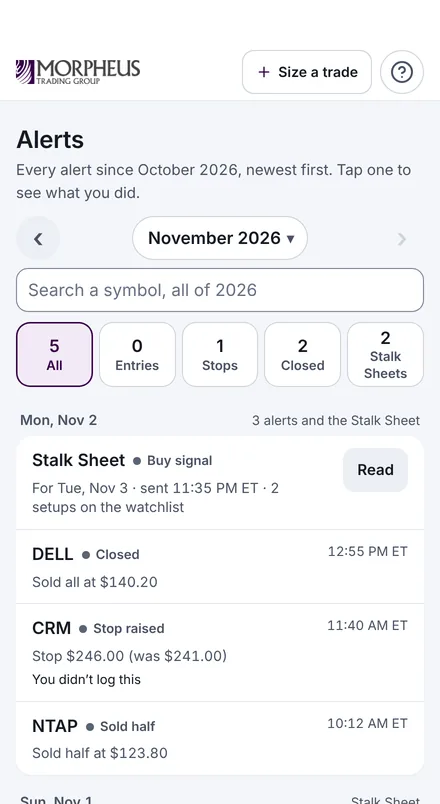
Rick sends the alert
Each alert goes out when the price reaches the entry, and it comes with the stop and Rick’s size call (such as full size or half size).
- 2
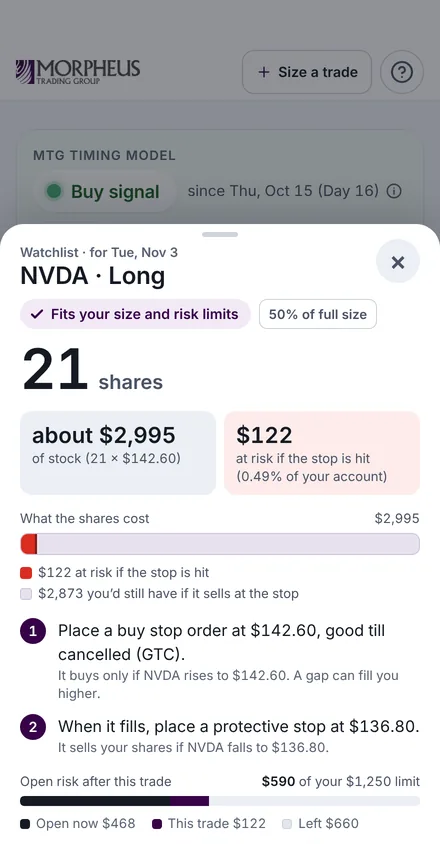
You tap “Size it”
The app turns the stop into your share count, from the account size and “risk” setting you choose.
- 3
You check the market call
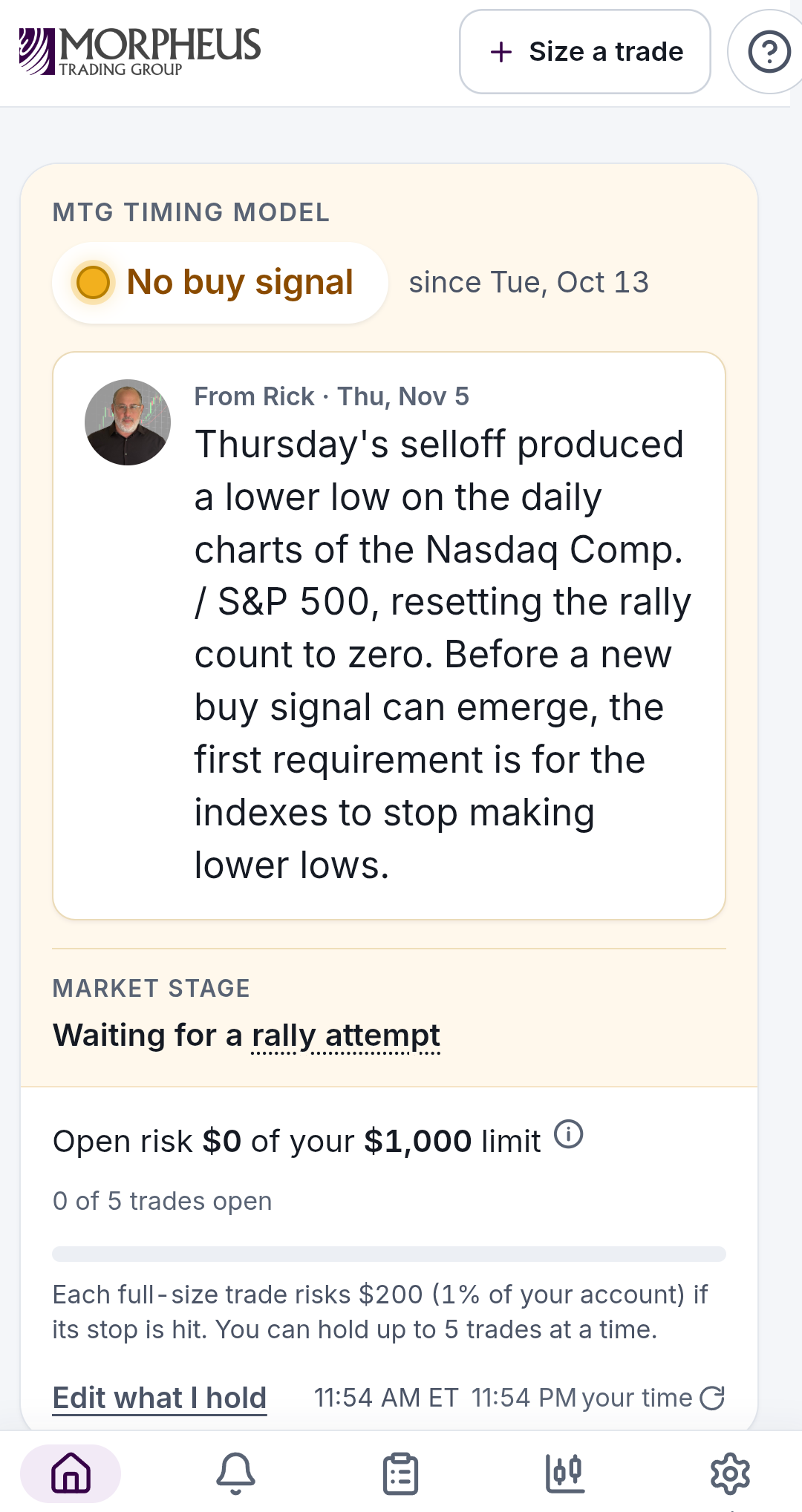
A Buy signal means the model allows new buys.
On a No buy signal, new buys are few or none, and the app shows a short warning before it sizes one, so the choice stays yours.
Swipe to see all three screens.
The Alerts and Size it screens are samples with made-up tickers, prices and dates, not real alerts or results. The market call screen is real, from November 6, 2026; its dollar limits are one member’s own settings.
You place every order at your own broker. The app opens in your web browser and never connects to your brokerage account.
Also included
- A members-only room with Rick and fellow traders, open 9:30 AM to 4:00 PM ET
- The Stalk Sheet: Rick’s watchlist and market notes for the next session, in the app and by email
- Rick’s open positions, with every stop move and sell
We keep adding tools to the app, and new ones are included in the membership.
Using AI for trade ideas?
AI can find you a stock. It can’t keep you from moving your stop.
An AI chat can list stocks in seconds, and it never gets tired.
What it usually can’t do is hold you to a plan when a trade starts moving against you.
AI finds ideas
Use it for research if it helps you.
It doesn’t know your account, and it can’t feel a losing streak.
The method sets the rules
Our written rules decide what to buy, when to buy, where the stop goes and how large each position is.
Rick applies them every day, and the Wagner Daily app uses the same rules to calculate your share count for each alert.
You keep the discipline
You take the trade, respect the stop, and hold off on new buys on a No buy signal.
- AI alone tends to trade too often.It gives you plenty of ideas, and nothing that says when to stay out of the market.
- Rules alone fall behind.Working out every share count by hand is slow, and easy to skip on a busy day.
- You alone can run out of energy.Tiredness and emotion creep in, and some trades get taken out of boredom.
No AI picks our trades. Rick does, using the rules, and the app does the sizing math.
Who Wagner Daily fits, and who it doesn’t.
A good fit if
- You want a plan before you buy, with the entry and the stop set first.
- You hold trades for days to a few weeks, which can fit around a full-time job.
- You trade US stocks and ETFs at your own broker.
- You’d rather hold cash than buy stocks in a weak market just to stay active.
Not a fit if
- You want day trades, or alerts on crypto, futures or forex.
- You want a promised return. There isn’t one, and you’ll have losing trades, sometimes several in a row.
- You want new buy alerts every day. On a No buy signal, there may be few or none for several weeks.
What a weak market looks like inside Wagner Daily
On a No buy signal, Rick is mostly in cash, with any positions small, and few or no new buy alerts go out. In mid-October 2026, for example, the model went to 100% cash.
That’s capital preservation, and it matters because a big loss takes a much bigger gain to win back.
If a weak market has been rough on your account, position size is often the first thing to check.
The model can be early, late or wrong, and time in cash can mean missed gains.
The people behind the alerts.
Rick Pedicelli
Head trader
Rick has chosen the trades behind our alerts for more than 20 years.
In the members-only room, open 9:30 AM to 4:00 PM ET, he and fellow traders compare setups. Members’ own ideas there are not MTG alerts.

Deron Wagner
Founder, Morpheus Trading Group
Deron started Morpheus Trading Group in 2002, after a career as a professional trader and hedge fund manager.
He has written or co-written five trading books, published by Bloomberg Press and Wiley.

New book: Why Swing Traders Sleep Better at Night
See the book“Knowing when to not trade is probably more important than knowing when to trade.”
“I love the action. I love being engaged. But without controlling that emotion, you’re not gonna consistently make gains.”
“Your app is fantastic. The community is great. I wish this had occurred earlier in my trading career.”
Member comments are individual experiences. Results vary and are not typical.
Membership
One membership, and everything below is included.
Annual
About $57 a month, and $488 less than paying monthly for a year.
Renews yearly until you cancel.
Monthly
Renews monthly until you cancel.
- Live trade alerts with the entry, the stop and Rick’s size call, plus every stop move and sell
- A members-only room with Rick and fellow traders, open 9:30 AM to 4:00 PM ET
- The market timing call, every day
- The “Size it” feature in the Wagner Daily app
- Rick’s open positions
- The Stalk Sheet: Rick’s watchlist and market notes for the next session
You pick annual or monthly when you join.
30-day confidence guarantee
We stand behind Wagner Daily, so your membership comes with a guarantee. The terms for each plan are shown at checkout, before you pay.
Common questions
Is a robot or AI picking the trades?
No. Rick chooses each trade himself, using the written rules Deron built.
The app only works out your share count.
How many trade alerts will I get?
On average, about 3 to 4 new trades a week.
On a No buy signal, there may be few or none for several weeks, though stop changes and sells on open trades still go out.
I work full time. Can I keep up?
Yes. Swing trades are held for days to a few weeks, not minutes.
The Stalk Sheet, Rick’s watchlist and market notes for the next session, gives an entry price and a stop for each stock he may buy, so you can plan before the market opens.
If a stock has already run well past its entry by the time you see the alert, skip it and wait for the next one.
I’m new to trading. Is this for me?
It can be, if you have placed trades before, because every alert comes with its entry and its stop, and the app works out your share count.
If you have never bought a stock, start with the free Intro to Trading course, and come back when you are ready.
What size account do I need?
The app works out each share count from your own account size and “risk” setting, so a smaller account simply gets fewer shares.
At 1% risk, for example, a $5,000 account would have $50 at risk on a full-size alert (the loss if the stop is hit at its price).
You choose your risk per trade, and you can start small while you learn the alerts.
I live outside the US. Will it work for me?
Yes, if your broker can trade US stocks and ETFs. The app works in any web browser.
Alerts go out during US market hours (9:30 AM to 4:00 PM New York time). If that falls during your night, plan ahead from the Stalk Sheet, which gives an entry price and a stop for each stock Rick may buy in the next session.
How is this different from other alert services?
Every alert comes with its stop set first, and the app works out the share count for your account.
We publish the losing trades along with the winners, and when the market turns weak, we keep new buying small or skip it.
I was a member before. What’s different now?
Rick still leads the alerts and the members-only room, using the same written rules.
The daily report you remember is now the Stalk Sheet, Rick’s watchlist and market notes for the next session, in the app and by email, and the app calculates your share count for each alert.
How do I cancel, and what is the guarantee?
Cancel anytime by emailing help@morpheustrading.com. Cancelling stops the next renewal.
The 30-day confidence guarantee covers your membership, not your trading results. Each plan’s terms are shown at checkout, before you pay.
Trade what you SEE, not what you think.
See Rick’s method, the app and the full record on the Wagner Daily page.
See how Wagner Daily worksNot ready? Take the free Trader Profile quiz.
Trading involves substantial risk of loss and is not suitable for every investor. Past results don’t guarantee future results. All content from Morpheus Trading Group is for educational purposes only and is not personalized investment advice.