
Weekly Market Snapshot, Issue 1: Day 4 of the Nasdaq Rally Attempt
Nov 11, 2026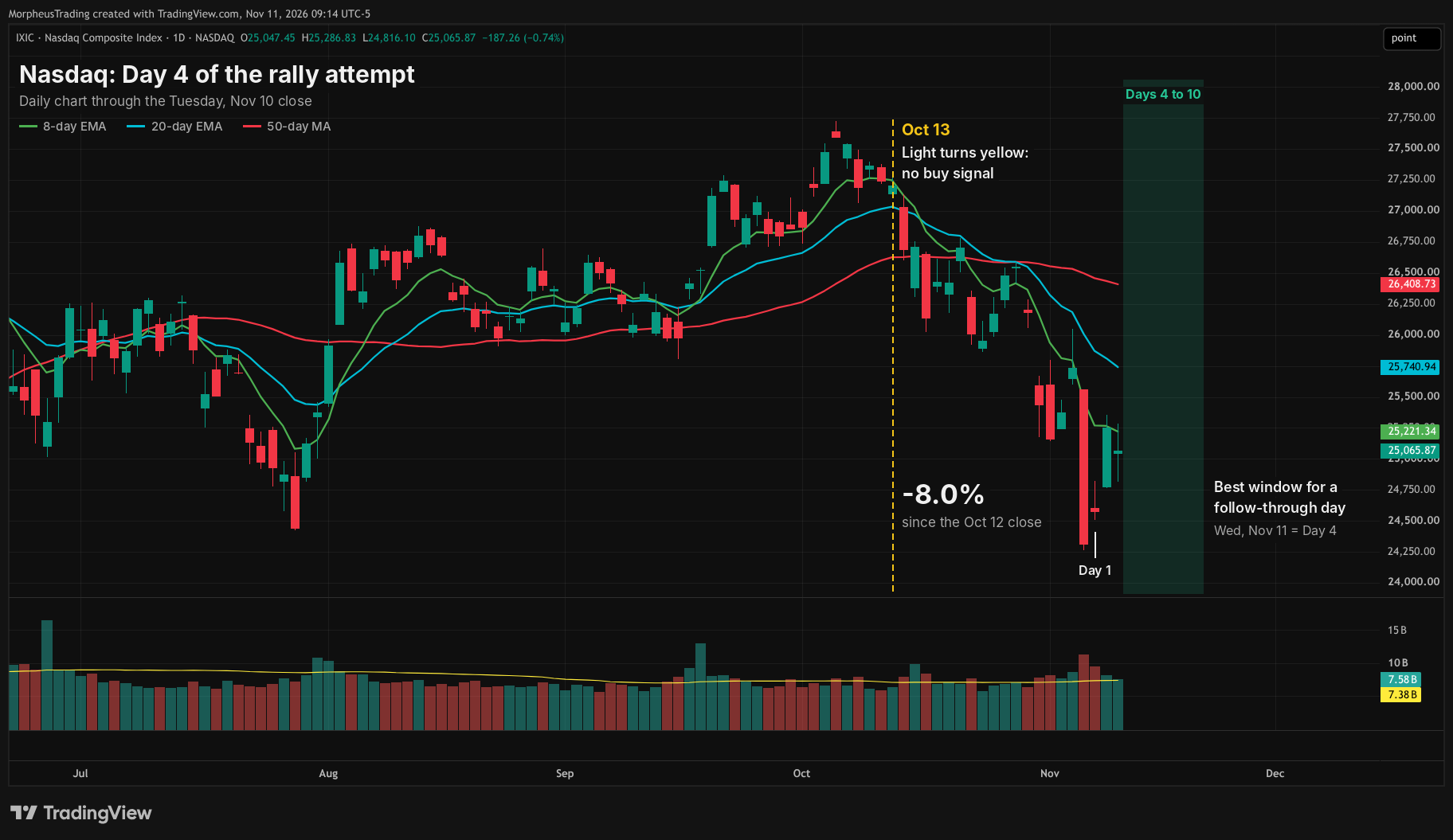
Issue 1, Wednesday, November 11, 2026. This page is a snapshot with market data through Tuesday's close.
A lot of traders have felt real pain in this market lately, and if you're one of them, you're not alone.
You may have taken some losses, but the best thing you can do now is be prepared for a possible rebound.
This is the first issue of our free weekly market snapshot, from the same team that has published Wagner Daily swing trade alerts since 2002.
The short version, as of the close on Tuesday, November 10:
- Our market timing light is yellow: no buy signal since October 13.
- The Nasdaq Composite is down 8.0% from its October 12 close.
- Wednesday, November 11, is Day 4 of a new rally attempt, the first days of a possible market bottom.
- A new buy signal ideally comes from a strong up day on higher volume, called a follow-through day, between Day 4 and Day 10.
As of the November 10 close, the light is yellow: no buy signal
The Morpheus Trading Group (MTG) Market Timing model works like a traffic light.
Green means a buy signal, so our rules allow new buys. Yellow means no buy signal, so new buys are rare, with tight stops and quick profit-taking, and we often sit in cash.
A stop is a price you set in advance, where you sell to limit a loss. Being in cash means not being invested in stocks.
It turned yellow on October 13.
Here's how the light looks in the Wagner Daily Stalk Sheet, the daily watchlist and market analysis from our head trader, Rick Pedicelli:
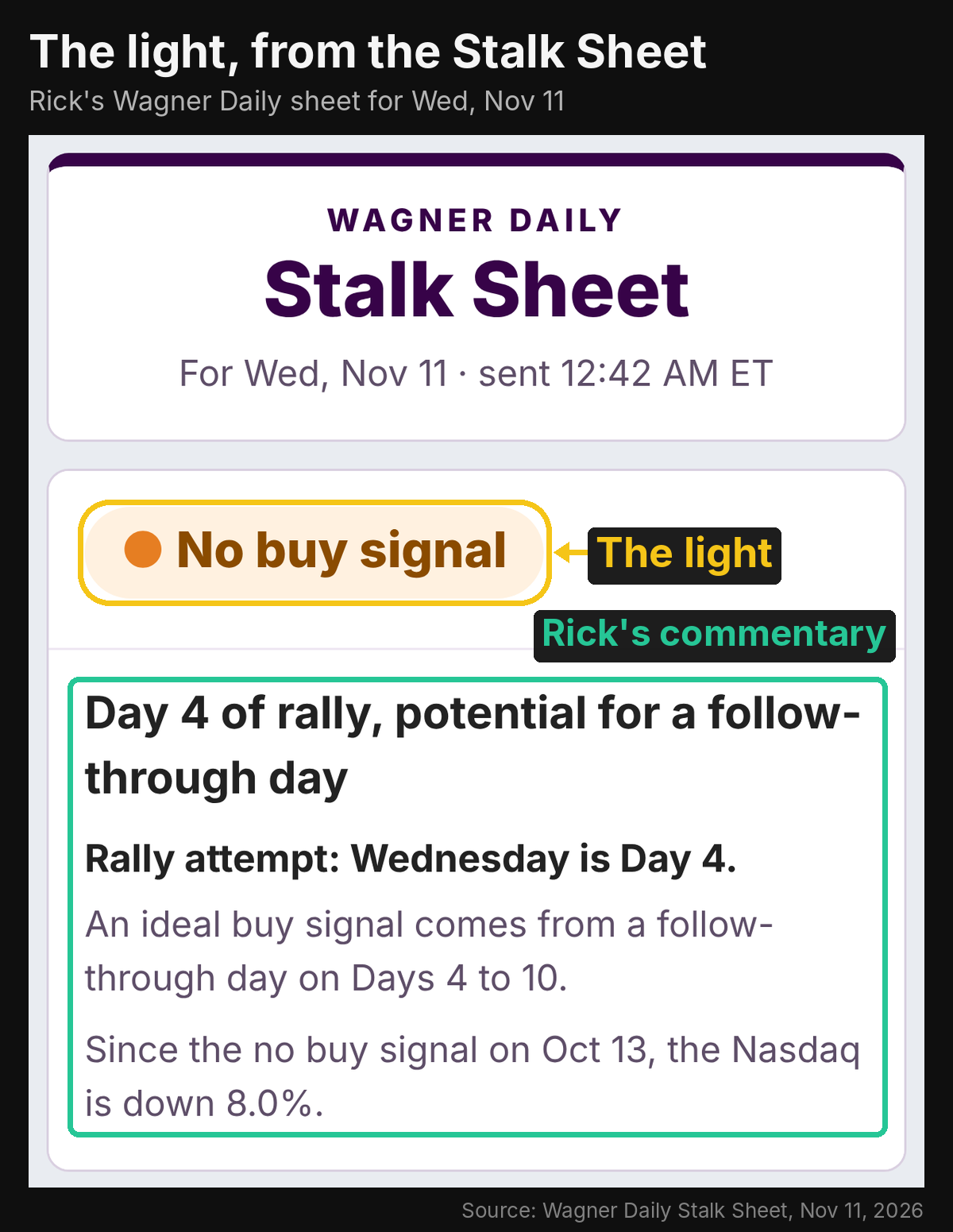
The top of the Wagner Daily Stalk Sheet for November 11, 2026.
Since October 13, the Wagner Daily model stock portfolio has been mostly in cash.
The model portfolio is a model rather than real money: it tracks the trades Rick publishes, as one portfolio.
Through Tuesday's close, it held just 1 position, the stock $CRM, from October 21 to 27, and sold it in 3 parts for an average gain of +1.8%.
Measured from the October 12 close, the day before it turned yellow, the Nasdaq Composite is down 8.0% as of Tuesday's close.
It closed at 27,245.90 on October 12 and 25,065.88 on November 10. The lowest close of this drop through Tuesday was 24,315.00 on November 5, down 10.8%.
We didn't predict this drop, we reacted to it.
THIS is how a rule-based methodology is meant to work.
Wednesday, November 11, is Day 4 of the new rally attempt
This bounce is a new "rally attempt," the first days of a possible market bottom.
Day 1 was Friday, November 6, when the Nasdaq made a higher low, which means a low above the previous low. That makes Wednesday Day 4.
Rally attempts can fail. A lower low resets the rally count to zero, as it did on November 5.
An ideal buy signal comes from a "follow-through day," a strong up day for the index on higher volume. The best ones come between Day 4 and Day 10.
Volume is the number of shares traded that day.
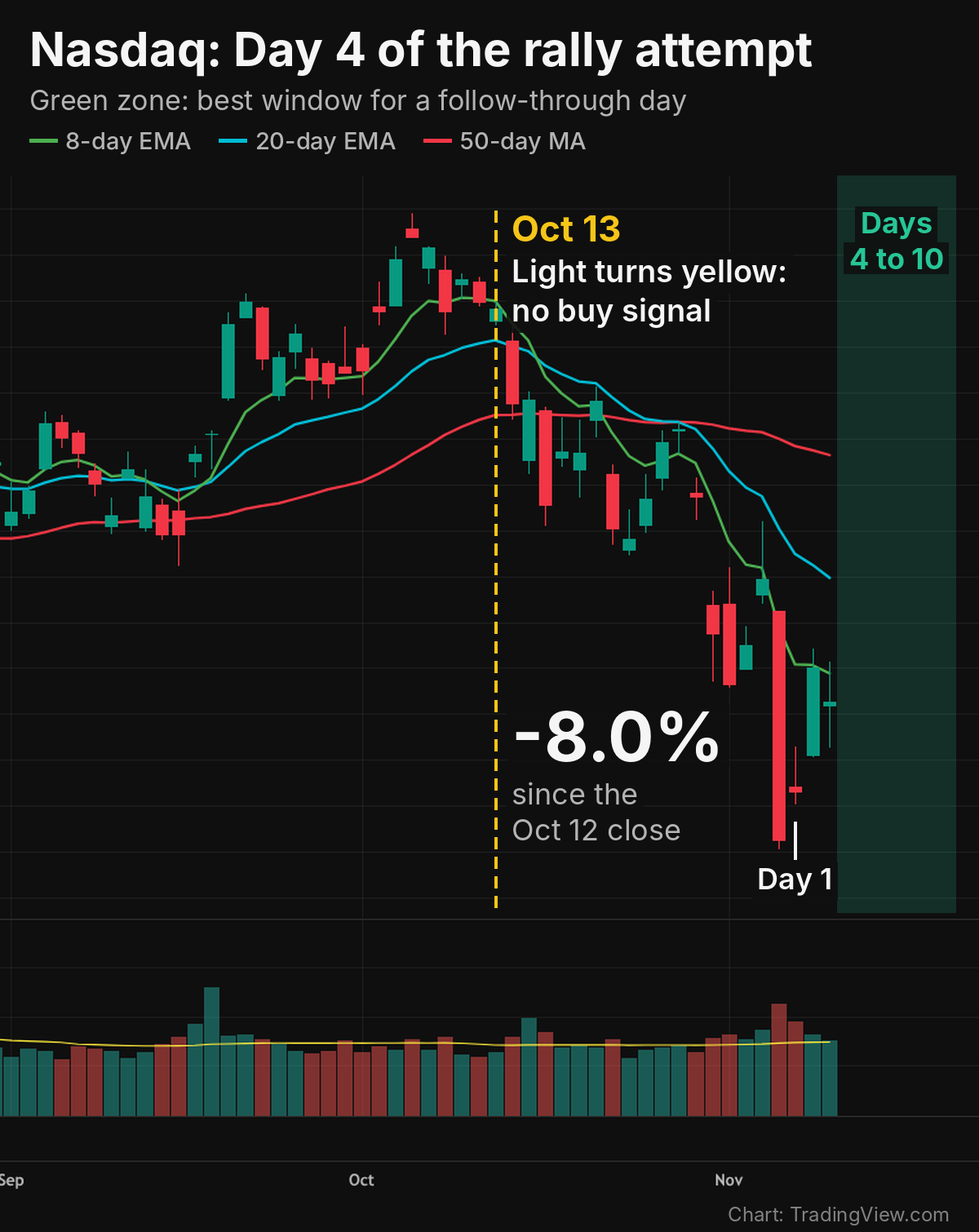
Nasdaq Composite, daily, through Tuesday's close, with the 8-day and 20-day exponential moving averages and the 50-day moving average. The 200-day is not shown.
For the Nasdaq to turn bullish, Rick first wants to see a follow-through day, along with a move back above its 8-day and 200-day moving averages.
A moving average is the average closing price over a set number of days. An exponential one gives more weight to recent days.
Until the light turns green, we stay mostly in cash.
Last time: getting back in
On March 5, 2026, the model turned to "no buy," and the Nasdaq Composite fell more than 8% from that day's close to its closing low on March 30.
It closed at 22,748.99 on March 5 and 20,794.64 on March 30.
A new buy signal came on April 8, and we began buying on April 9.
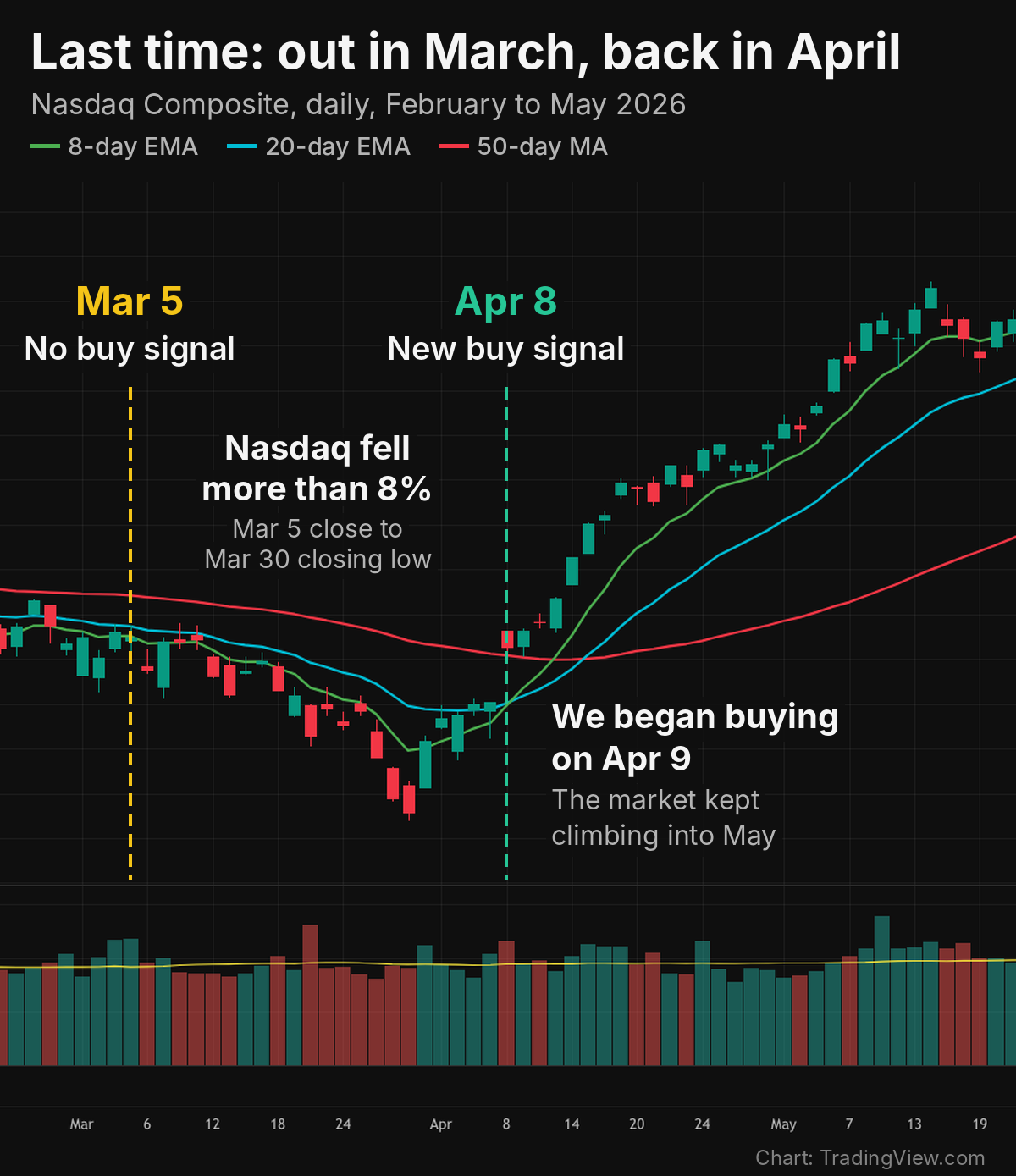
Nasdaq Composite, daily, February to May 2026, with the March 5 no buy signal and the April 8 buy signal marked.
Here is how that went in the Wagner Daily model portfolio, a model rather than real money.
Counting each full or partial exit, about six in ten of the roughly two dozen closed trades from positions we opened in April were winners.
The average winner was +22.5% and the average loser was about -4%.
These are per-trade price moves before commissions and slippage, not account returns.
The market then kept climbing into May, and traders who waited for a pullback may have been left on the sidelines.
Getting back in matters as much as getting out.
April was the strongest month for the positions we opened, with the best win rate and the best average gain per trade of the six months in the record.
For the bigger picture, our latest published six-month record for the model portfolio (January to June 2026) shows 102 closed trades, counted the same way.
Of those, 44% were winners, the average winner was +14.8% and the average loser was -3.8%, and the record is unaudited. We update it about every six months.
See the published record and how Wagner Daily works.
How we get ready: relative strength
Our strategy is built on relative strength.
We look for the stocks that hold up best while the market is weak, because they often lead when it turns up.
Rick's Radar lists stocks he's watching, ideas for experienced traders, not alerts or recommendations.
MTG and its staff may hold positions in them.
From the room: what two graduates told us
At a live Q&A with our course graduates on November 8, Ev, who has traded for over 45 years, said he hasn't traded since October 8.
He said that believing he could always find a trade and "make it work" was "the biggest lie I ever told myself."
Jon D., another graduate, bought $NUE after a month of waiting, and he admits he "probably shouldn't have taken the trade" with no buy signal.
When it fell with the market, he sold at his stop for a loss of about $90.
His advice: "Take the loss. Your stop is your stop."
Ev and Jon are describing their own trades, not the model portfolio.
As I told the group, "You can have the great setup, but if the timing's off, then nothing else matters."
Be ready for the next buy signal
Wagner Daily members get the daily Stalk Sheet and Rick's trade alerts when he buys and sells.
If a new buy signal comes, they'll see the light turn green in the Wagner Daily app, and the app helps them size each position and manage risk for their own account.
If you don't want to be left on the sidelines next time, see how it works.
Not ready yet? Take the free Trader Profile quiz.
Trade what you SEE, not what you think.
Deron Wagner
Founder | Morpheus Trading Group
Trades and portfolio details come from the alerts and daily reports The Wagner Daily sent to members at the time. They describe MTG's model portfolio, are unaudited, and exclude commissions and slippage. Each full or partial exit counts as one closed trade. Stops can fill below their price. Comments from course graduates describe their own trades and experiences, not MTG's model portfolio. Stocks on Rick's Radar are ideas, not recommendations, and MTG and its staff may hold positions in them.
IMPORTANT DISCLAIMER: Past results don't guarantee future results. Trade examples are published trade alerts from The Wagner Daily, are per-trade price moves, and are not account returns. All content from Morpheus Trading Group (MTG) is for educational purposes only and is not personalized investment advice or a recommendation to buy or sell any security. Trading involves substantial risk of loss and is not suitable for all investors.
